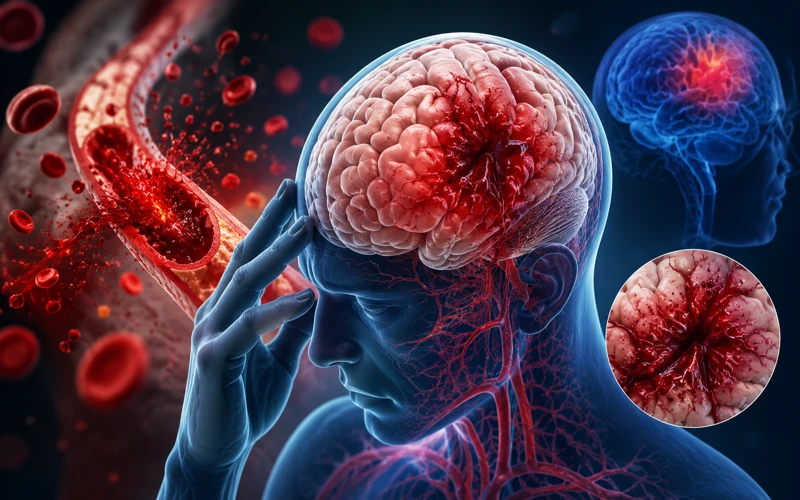
Brain haemorrhage (brain bleed) has an overall mortality rate of around 30%–40% in the first month, making it a critical medical emergency where outcomes depend heavily on timing and severity of neurosurgical treatment.
A brain haemorrhage occurs when a blood vessel in the brain ruptures, leading to internal bleeding and pressure buildup inside the skull. This condition can quickly damage brain tissue and become life-threatening if not treated immediately.
The question “Is brain haemorrhage curable?” does not have a simple yes or no answer. In mild cases where bleeding is limited and treatment begins within the early “golden hours,” patients can recover significantly. However, in severe cases involving large bleeding or deep brain damage, complete recovery may not be possible even after surgery.
This article explains brain haemorrhage types, symptoms, treatment options, surgery requirements, survival rates, and recovery chances in a clear, structured way, including what patients and families in Delhi should know during emergencies.
Is Brain Haemorrhage Curable or Not?
Brain haemorrhage is not always fully curable, but it is treatable, and many patients can survive and recover depending on severity, location of bleeding, and how quickly treatment begins.
The outcome of a brain haemorrhage depends on how much bleeding has occurred and which part of the brain is affected. Small or moderate bleeds detected early can often be managed with ICU care and medication, sometimes with significant recovery.
However, in severe cases where there is extensive bleeding or high pressure on critical brain areas, complete recovery may not be possible even after neurosurgery.
Types of Brain Haemorrhage (and Which Are Most Dangerous)
Brain haemorrhage is classified into 4 main types based on where the bleeding occurs in the brain or surrounding layers, and each type has different severity and recovery outcomes.
1. Intracerebral Haemorrhage
This is bleeding directly inside the brain tissue and is one of the most serious types.
- Most commonly linked with high blood pressure
- Can rapidly increase brain pressure
- Often requires ICU care and sometimes surgery
- Higher risk of disability or death
2. Subarachnoid Haemorrhage
This occurs when bleeding happens in the space between the brain and its covering membranes.
- Commonly caused by aneurysm rupture
- Sudden severe “worst headache of life”
- High risk of complications like re-bleeding
- Requires emergency hospital treatment
3. Subdural Haemorrhage
Bleeding occurs between the brain and outer protective layer (dura mater).
- Often caused by head injury or trauma
- Can develop slowly or quickly
- More common in elderly patients
- Treatable if detected early
4. Epidural Haemorrhage
This type occurs between the skull and outer brain covering, usually due to trauma.
- Often linked to skull fractures
- Can have a “lucid interval” before symptoms worsen
- Requires emergency surgery in many cases
- Rapid intervention can be life-saving
Brain Haemorrhage Symptoms (Emergency Warning Signs)
Brain haemorrhage often presents with sudden and severe neurological symptoms, and in many cases, the condition worsens rapidly within minutes to hours, requiring immediate emergency care.
1. Sudden Severe Headache
A sudden, extremely intense headache is one of the most common early warning signs, often described as the “worst headache of life,” especially in subarachnoid haemorrhage.
2. Vomiting and Nausea
Increased pressure inside the skull can cause repeated vomiting without relief, often occurring alongside headache and dizziness.
3. Weakness or Paralysis
Patients may experience sudden weakness or numbness on one side of the body, including face, arm, or leg.
4. Loss of Consciousness
Severe brain bleeding can cause fainting, drowsiness, or complete unconsciousness, indicating serious brain pressure.
5. Speech and Vision Problems
Symptoms may include:
- Slurred or unclear speech
- Difficulty understanding words
- Blurred or double vision
6. Seizures
In some cases, brain haemorrhage can trigger sudden seizures due to abnormal brain electrical activity.
Brain Haemorrhage Treatment in Dwarka, Delhi
Brain haemorrhage treatment focuses first on saving life by controlling brain pressure, stopping bleeding progression, and stabilizing vital functions in an ICU setting.
Treatment begins immediately after hospital admission because brain cells start getting damaged within minutes due to increased pressure and reduced oxygen supply.
1. Emergency ICU Stabilization
The first step in treatment is stabilizing the patient in the Intensive Care Unit (ICU).
- Oxygen support to maintain brain oxygen supply
- Blood pressure control to reduce further bleeding
- Continuous neurological monitoring
- IV fluids and emergency medications
2. Medicine-Based Treatment in Delhi
In less severe cases, doctors may manage brain haemorrhage without immediate surgery using medications.
- Drugs to reduce brain swelling
- Medicines to control seizures
- Blood pressure-lowering medications
- Reversal of blood-thinning agents (if applicable)
3. Monitoring Brain Pressure (ICP Control)
In severe cases, doctors monitor intracranial pressure (ICP) to prevent brain damage.
- Helps detect worsening bleeding
- Guides need for surgical intervention
- Prevents further brain injury
4. Emergency Neurosurgical Intervention
If bleeding is large or pressure is life-threatening, surgery may be required.
- Removal of blood clot (hematoma evacuation)
- Reduction of brain pressure
- Repair of ruptured blood vessel (in selected cases)
Brain Haemorrhage Surgery in Delhi (When Operation Is Required)
Brain haemorrhage surgery is required only in severe cases where bleeding is large, brain pressure is increasing, or the patient’s life is at immediate risk despite ICU treatment.
Surgery is not the first option in all cases. Doctors first try ICU stabilization and medication, but when brain compression becomes dangerous, surgical intervention is considered.
1. Craniotomy (Most Common Surgery)
This is the most widely used procedure for brain haemorrhage.
- A part of the skull is temporarily removed
- Blood clot (hematoma) is carefully removed
- Pressure inside the brain is reduced
- Skull is placed back after stabilization
2. Hematoma Evacuation
This procedure focuses on removing accumulated blood inside the brain.
- Reduces pressure on brain tissue
- Prevents further brain damage
- Used in large intracerebral bleeds
3. Life-Saving Emergency Surgery
In critical cases, surgery is performed immediately when:
- Bleeding is rapidly increasing
- Patient is unconscious or deteriorating
- Brain swelling is life-threatening
Brain Haemorrhage Survival Rate (Realistic Outcomes)
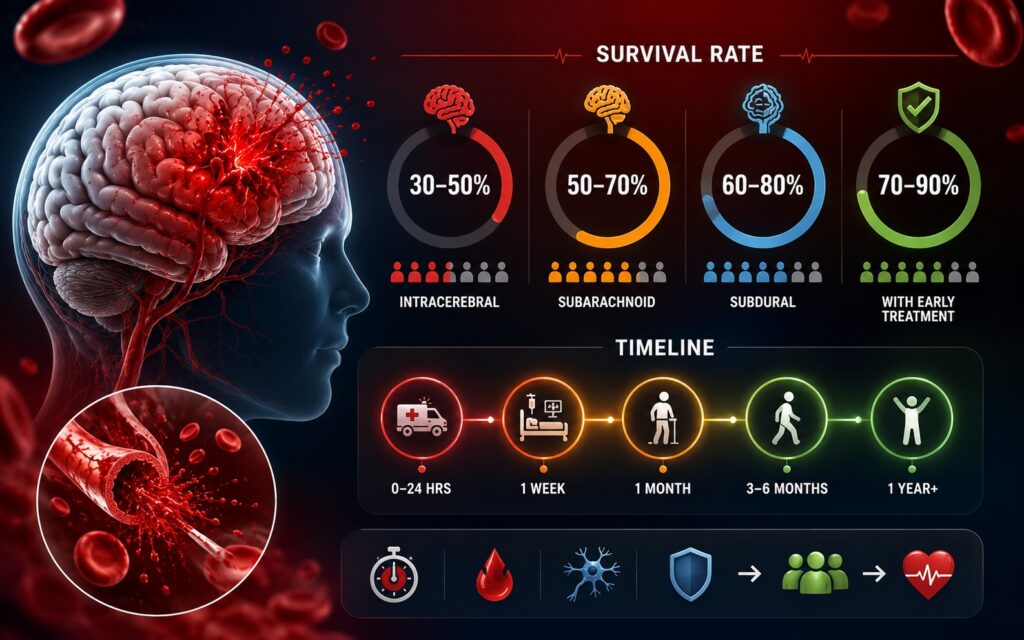
Brain haemorrhage survival rate varies widely from case to case, but overall 30-day mortality is approximately 30%–40%, making it one of the most serious neurological emergencies.
Survival depends mainly on bleeding size, brain area affected, patient age, and how quickly treatment begins.
1. Mild Brain Haemorrhage Cases
In small or localized bleeds:
- Higher chance of survival with timely ICU care
- Many patients recover partially or fully
- Neurological deficits may be minimal
2. Moderate Brain Haemorrhage Cases
When bleeding is moderate:
- Survival depends on early hospital treatment
- Some patients recover with rehabilitation
- Risk of long-term neurological impairment increases
3. Severe Brain Haemorrhage Cases
In large or deep brain bleeding:
- High risk of death or coma
- Survival chances significantly reduced
- Even surgery may not fully reverse damage
Brain haemorrhage surgery is considered worth it in many severe cases because it can be life-saving, but it does not guarantee full recovery and outcomes depend on brain damage already caused before surgery.
Surgery is not performed in all patients. Neurosurgery doctors in Dwarka carefully evaluate whether removing the blood clot or reducing brain pressure will improve survival chances.
Brain haemorrhage is a life-threatening medical emergency where outcomes depend on bleeding severity, brain location, and how quickly treatment is started. While it is not always fully curable, many patients can survive and recover partially or significantly when treated within the critical early hours. Mild cases often respond well to ICU care and medication, while severe cases may require emergency surgery and still carry risk of long-term complications. The key medical reality is that brain haemorrhage is treatable but time-sensitive, and immediate hospital intervention plays the most important role in improving survival and recovery chances.
At the Center for Brain and Spine, Delhi, patients receive specialized care for emergency neurological conditions, including brain haemorrhage management, advanced neuro-imaging, ICU support, and neurosurgical intervention when required.
If you are in Delhi, seek immediate consultation with a neurosurgery specialist at Center for Brain and Spine for urgent evaluation and treatment guidance.